The news#
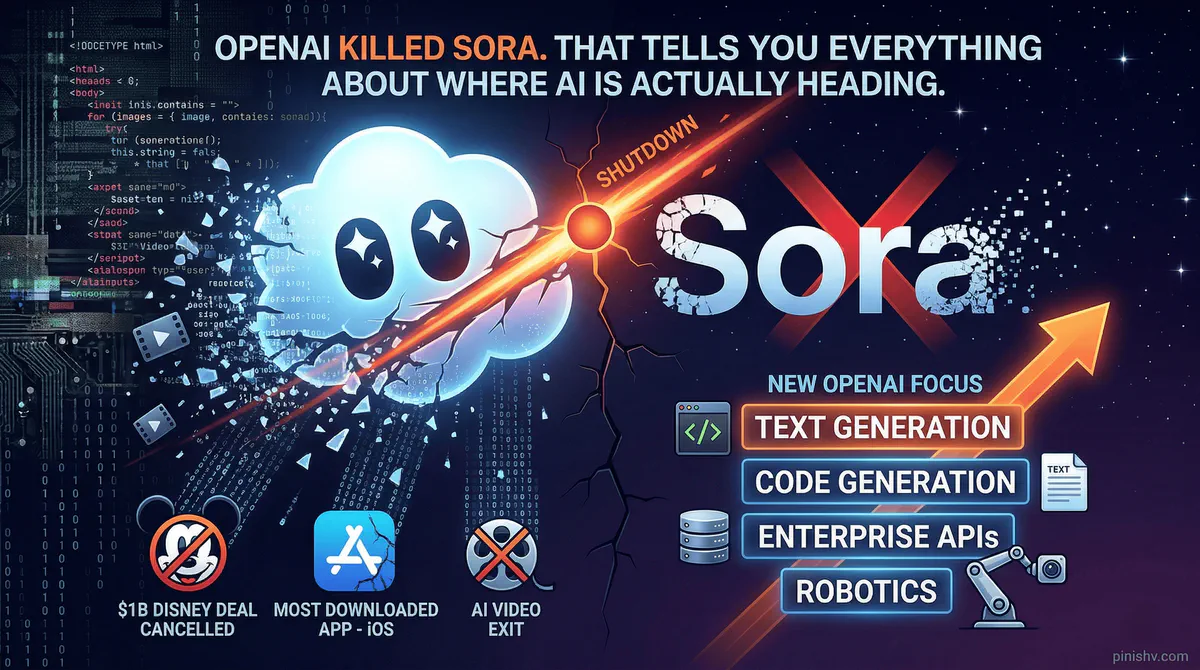
OpenAI announced on March 24 that it’s shutting down Sora and exiting AI video generation entirely. The consumer app, the API, the video features in ChatGPT. All being wound down. Disney’s $1 billion partnership deal, signed just three months ago, is dead.
This was the app that became the most-downloaded in iOS Photo & Video within a day of launch. The app that got Disney to license Mickey Mouse to an AI company for the first time. Gone.
OpenAI says it’s reallocating compute to text and code generation (which make more money) and robotics (where the video research transfers directly to teaching machines how to move in physical space).
My take#
This is the most honest decision OpenAI has made in a while.
Sora was impressive technology burning compute at a rate that made no business sense. Bill Peebles, OpenAI’s head of Sora, had already imposed usage limits in October due to chip constraints. With an IPO coming at a $730 billion valuation, you need revenue, not viral demos.
The Anthropic comparison is telling. Anthropic never touched image or video generation. Every GPU went to text and reasoning. Claude became a serious enterprise tool. OpenAI is now mirroring that strategy, years later, after taking the scenic route.
I wrote recently about how the value is shifting from interfaces to infrastructure. Sora was an interface play: consumer video, creative tools, Disney characters. OpenAI is now betting the real money is in infrastructure: enterprise APIs, developer tools, code generation. That’s probably the right bet. But it means a $1 billion Disney deal wasn’t worth the compute it required.
What this actually signals#
Compute is the constraint, not capability. Sora could generate incredible video. The problem was never quality. It was cost per output. Every GPU running video is a GPU not running enterprise text. OpenAI chose revenue over demos.
Enterprise wins over consumer. OpenAI’s CFO said they expect to be 50-50 enterprise and consumer by year end. Killing the flashiest consumer product to double down on enterprise tells you which side has better margins.
The robotics pivot is the quiet bombshell. They’re not abandoning the Sora research. They’re redirecting it from generating videos people watch to controlling machines that move in the real world. That’s a much bigger market.
The bottom line#
The best-funded AI company in the world looked at its most viral product, did the math, and shut it down. Not because it didn’t work. Because it didn’t pay.
The demo era is ending. The “what actually generates revenue” era is starting. And for OpenAI, the answer is text, code, enterprise APIs, and eventually robots. Not videos of woolly mammoths walking through snow.
What do you think? Right call or a mistake? Find me on X or Telegram.